Monday, 18 March 2019

Manaus, Amazon

Amazon trip

On our way through the jungle to get to Manaus, we found a new friend, a playful parrot. It was very selective and only seemed to like the girls.


And then finally we got to Manaus, famous for its opera house completed in 1896 at the height of the rubber boom.
The monument in front of the opera house.
And then it was off to the port and this was to be home for the next six days as we took the ferry for the 1,500 kms trip up the Amazon from Manaus to Tabatinga.
A front view of the ferry and my cabin is at the front on the right hand side as you look at the ferry.
Some of the flooded jungle,
...some of the other traffic on the river...
...more flooded jungle...

 ...and one of the sunsets...
 ...and another...


Monday, 4 March 2019

Guyana Eco Lodge

Guyana Eco Lodge

We eft Georgetown and after an hour of driving we left the tarmac an for the next 460 kms it would be just dirt track. And it was slow going and we barely made 20 km an hour.
Plus an enforced stop fo.r a ferry across the river and they only go when they are full
But it was all worth while as we were going to an eco lodge and had a three hour river ferry to get there in small boats.
Noodles and I in the boat.
A view of the wide slow running river.
Getting to the lodge at dusk.
The next day we went for a safari and looked out over a lake with masses of birds and fish.
Plus a caiman lurking nearby for any passing prey.
So this little colourful bird had to watch its step to avoid the caiman.
 And then it was back home.
 A view of the lodge.
O
 One of the cabanas.
a peacock fish, just the same as I had seen in the lake but this one was going to be my lunch.
 An acute running along the bank.
 An anaconda, over 5.5m long and huge so its a poor photo but I wasn't going any nearer.
 And then over the border into Brazil and passing over the equator.


Sunday, 24 February 2019

Georgetown, capital of Guyana

Georgetown, capital of Guyana

After all the all night celebrations of the last few days, it was Hang Over Sunday and a day to recover before returning to normal on Monday morning. I expected the city to be quiet and certainly the previous night's revellers were still in bed but not everyone had had a late night and certainly not parents with young children.

I walked down Vlissengen Road, one of the main roads and the route of the parade and it wasn't a lie in for hundreds of council workers and volunteers who were clearing up the debris left over from the night before and judging by the mountains of empty plastic bottles and beer bottles, cans, fast food trays and all sorts of other litter, it would take some time to clean up the place.

I was on my way to the Botanical Gardens. Thee are meant to be manatees here but the manatee pools were quiet, full of algae and floating plants and not a ripple on the surface.

 The Kissing Bridge in the Botanical Gardens.
 Several different types of habitats found in Guyana are represented such as upland areas, mangroves, seasonal flooded areas, savannah and so on. This is a photo of one of the many drainage channels all around the city including in the gardens, taken to show the pink flowers of a water plant.
 The Catholic Cathedral of the Immaculate Conception.
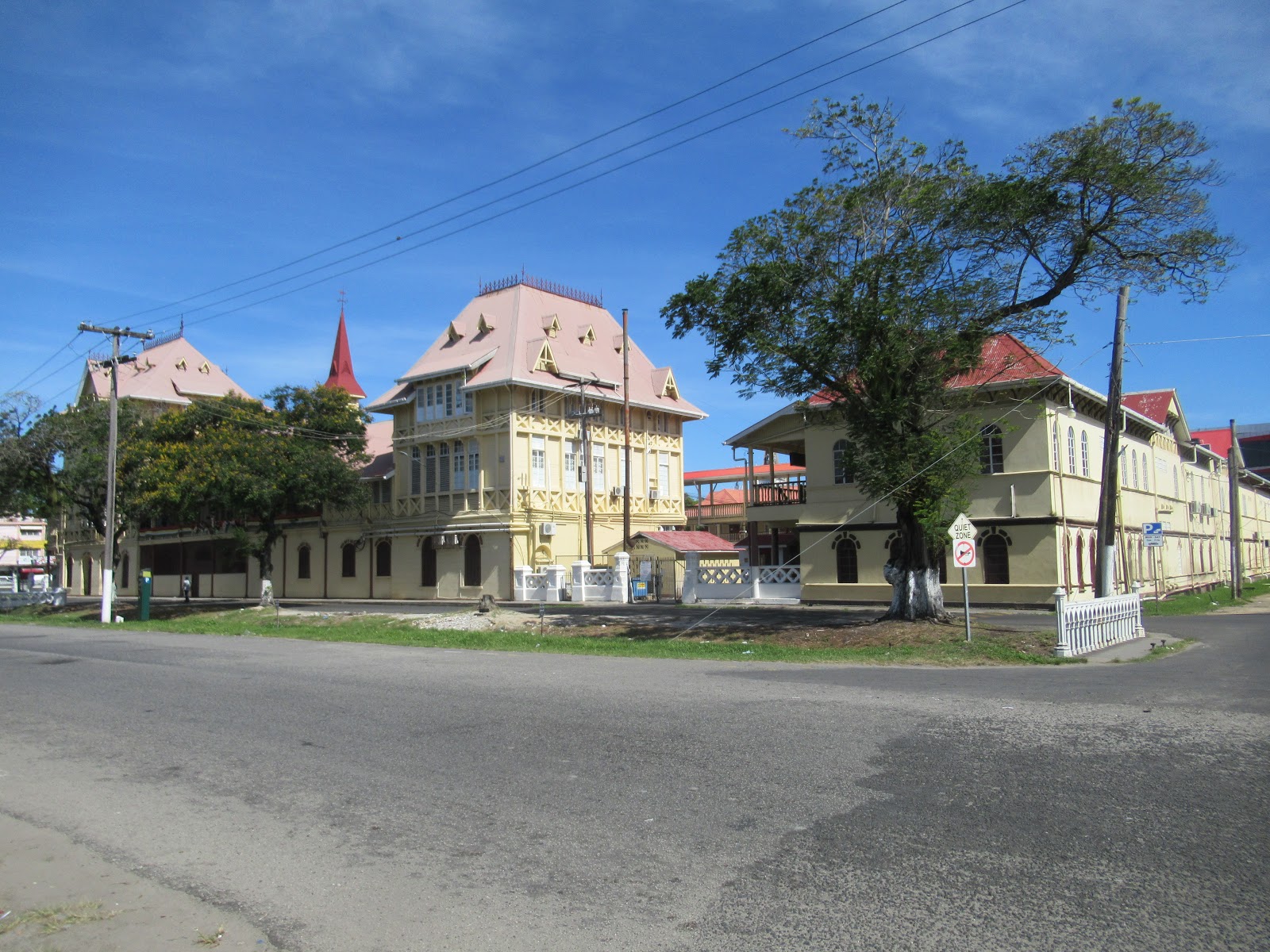
 The Palace of Justice, two views of this impressive wooden building.

 The Stabroek Market, made by the Edgemoor Iron Co in Delaware, USA and shipped here and completed in 1881, made from iron, steel and corrugated iron sheeting.
 A close up of the tower. It doesn't have a distinct architecture style but is reminiscent of Victorian era  Gothic style with the clock tower having more than a passing resemblance to St Stephens Tower of the Houses of Parliament which houses Big Ben.
 Just one of many interesting colonial era buildings.
 Government House.
 City Hall although it needs a little work and see paint. The Republics 50th anniversary is next year so I am hoping to see some changes over the next year.
 A side view of St Georges Cathedral.
 A view of the east facade.
 The Walter Roth Museum of Anthropology which was high on my list of places to see but it was closed.
 The Prime Misters Official Residence.
 I just happened to pass this and it wasn't on my list of places to see but it is the Court of Appeal but it looks more like any other large residential house.
 The light house which stands on the site of an earlier light house built by the Dutch in 1813 but this was built b the British in 1830 and stands 103 feet high. It used to send a light more than 30kms out to sea but ships more use electronic beacons. Just as well as today there is a ten story Marriott Hotel between it and the sea.
 The sea wall built by the Dutch which protects the city which is largely two metres below sea level.
And lastly at the National Park, I saw manatees but the water was murky and there was little to see. This is the head of a manatee with the nostrils and eyes.
But often all you see are the nostrils as they stay submerged and only expose their nose to breath and to eat the weeds and vegetation floating on the surface.


Guyana Republic Day

Guyana Republic Day

Guyana used to be a British colony but it became a republic n 23rd February 1970 and it celebrates it in style with three months of events and climaxing with a formal parade and a flag raising ceremony in front of the president and prime minister at midnight. The military and high ranking officials probably go to bed but for many it is the start of a big party with street food, stalls selling all kinds of goods and informal bars selling cold drinks out of insulated and iced chill boxes. There is also a paint throwing contest on a stretch of waste ground on the outskirts of town and you are warned to go in old clothes even if you are not going to participate as paint gets everywhere.

Then there is a lull as celebrations move on to a big parade that starts at midday and continues well into the evening. It is commonly called Mash, short for Mashramani, a mixture of local Amerindian and Guyanese Creole words meaning 'celebration after cooperative work'. Probably the worst job for a policemen on Mash Day is crowd control as many people came to town for the celebrations from all over the country which also means that hotels are all full up and increase their prices.

Just one of many floats.
There is lots of loud music from the stalls as well as from the bands on the floats such as this steel band.
One of the government floats with large green thing above the mans head is an outline of the country with two colourful toucans on each side.
A contraption on wheels pulled by a single person representing the world surrounded by olive branches and a white dove symbolising world peace.
A Chinese red dragon representing hope and luck.
Some of the many walking followers behind one of the floats.
A man on stilts walking in front of his float.
A float in the form of a digger representing one of the construction companies taking part in the parade.