Saturday, 28 September 2019

Rostov Lelivky,

Rostov Lelivky, Rostov the Great, so called to distinguish it from Rostov on Don.

An hour away from Yaroslavl is the ancient city of Rostov and its Kremlin. One of its many towers.
 The entrance to the kremlin.
 One of the many churches and cathedrals within the kremlin. One of the very few buildings which used stone rather than brick.
 The main entrance.
 The belfry, with small large bells up ti 32 tons and a church within the same building.
 A view across the pond within the kremlin.
 A small church within the kremlin.
 Yet another church.
 The main church.
Inside the main church, under going restoration but worked is suspended as the restoration is attempting to put in some heating as this church is open throughout the year but the ancient church doesn't allow for introduction of new pipes so work is suspended.
 Some of the empty icon positions, removed for safe keeping
 Some of the scaffolding still in position awaiting the outcome of protracted negotiations about restoration.
 And later it was the Spaso Yakovlevsky Monastery.
 A side view of the cathedral...
 ...and a frontal view.
 The eastern entrance...
 ...a view of the cathedral...

 A view of the three churches from the walls of the monastery.

Yaroslavl

Yaroslavl

Yaroslavl was founded in 1010 on a spit of land where the Kotorosl river joins the Volga. I was welcomed to the city by the harbour building siting on the lower bank of the Volga.
 There was a bridge than connected the top of the banks of the river nigh above the river.d allowed goods to be transported from the riverbank up to the plateau that sits h
One of the two city gates that still survive although the city walls were demolished in the 19th century.
And the entrance to the Monastery of the Transfiguration.
 One of the buildings within the grounds.
 The belfry.
 More impressive buildings and the cathedral.
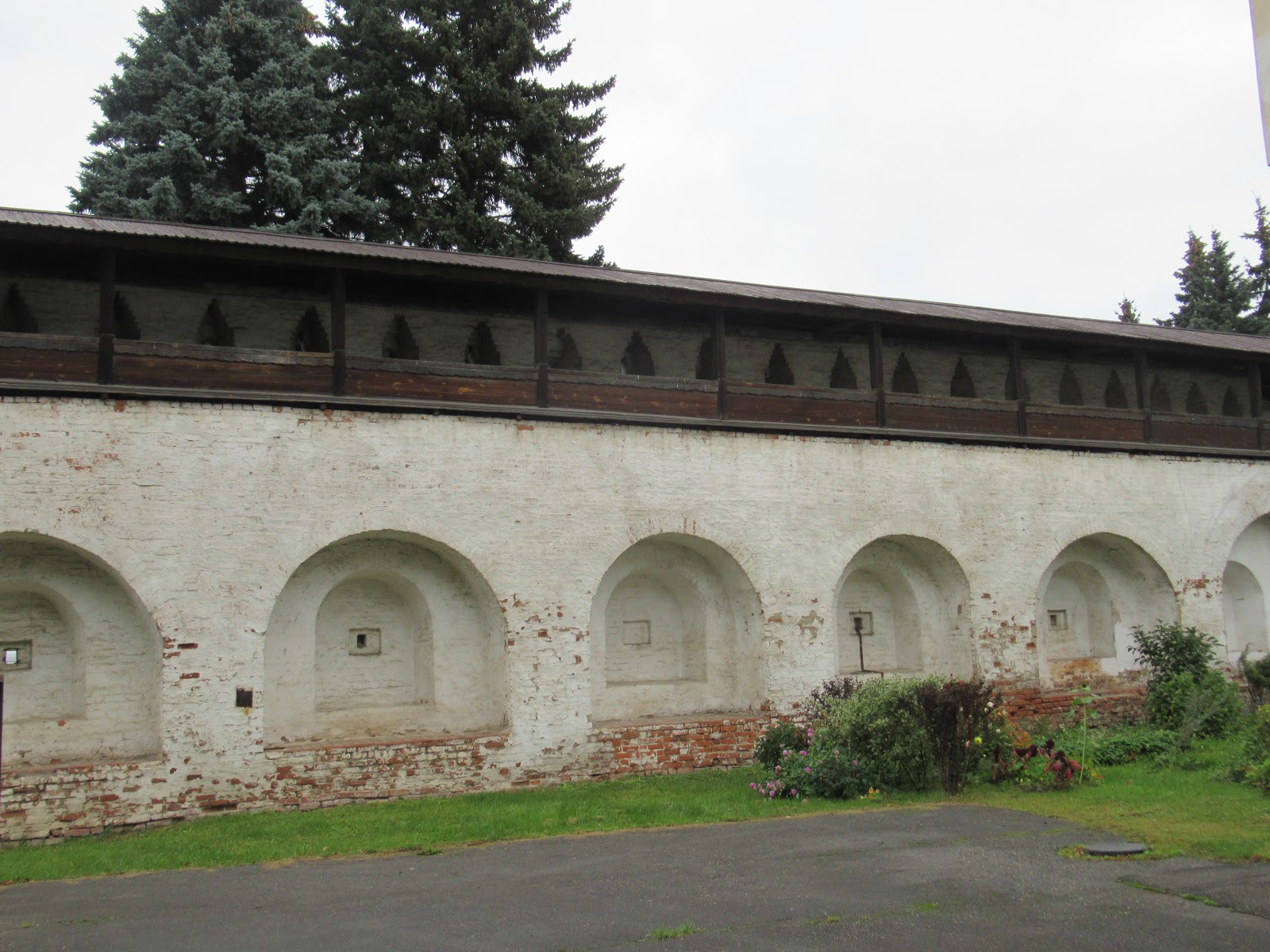
 Some of the surrounding walls seen from the inside.
 A view of one of the gates into the monastery area , viewed from the inside.
 Outside the monastery is a park and in it are several metal 'trees' to hold the many padlocks that lovers like to leave. The padlocks are a significant problem as they add weight to bridges and make maintenance difficult to undertake, hence the rise of metal 'trees'.
 Another eternal flame.
 And then there is the Cathedral of the Assumption, built in a traditional style but actually reconstruction of the original building destroyed by the Bolsheviks, created for the millennium celebrations of the founding of the city.
 An eternal fame in front of the cathedral.
 The entrance to the cathedral.
 Inside the cathedral.
 Looking down from the banks of the river to a low spit of land with the Volga to the left and the Kotorosl river to the right. The symbol of the city a an upright walking bear carrying a spear with the year 1009.

  The Church of Elijah the Prophet, a view from the front.

A view of the side of the church.
Inside the main summer church.
 Inside the winter church.


Friday, 27 September 2019

Moscow for Uglich

Leaving Moscow for Uglich

Time for a city tour, starting at the Sparrow Hills set 100 metres above the Moscow River and home to one of Stalin's sever sisters, built after he saw pictures of the Chicago skyline and reports of the completion of the worlds then highest building in New York of the Empire State Building. The State University, 260 metres tall to the star on the tip of the spire.

 Not the two red and white towers but between them is the city's tallest structure, just visible in the far distance.
 Moscows skyscrapers ib the business district.
 One of the worlds ugliest monuments to commemorate Peter the Greats foundation of the navy.
 In Red Square, the GUM department store, built in classical style.
 Inside GUM with its expensive shops, tiers of shops and walkways between levels and the glass domed roof.
 Harvest festival  on the ground floor of GUM.
 One of the entrances to Red Square adjacent to the red brick museum.
 Fire drill on board.
 Some shipping on the Volga.
 The belfry of Kalyazin now surrounded by the waters of the reservoir created by the dam downstream.
 The municipal offices o Uglich, a city 200 years older than Moscow.
 The bridge over the oat and entrance to the kremlin.
 A former church whose cupolas were removed when the Bolsheviks converted it to a cinema and now a museum.
 The cathedral of Uglich.
 The bell tower.
 The throne room...
 ...the ornate entrance to the throne room.
 The Tsarevich cathedral, built on the spot where the eight year old tsarevich, son of Ivan the Terrible, was murdered by Boris Godunov who was ruling as regent and then became tsar.
 A typical wooden house in the high street.
 The eternal flame in a public park near the river port.