Sunday, 15 April 2018

Felix Unite, near the border with South Africa

The Orange and Fish Rivers are the only rivers that flow throughout the year in Namibia . We were going to camp next to the Orange River. After hours of just desert, there was a sudden splash of green of fields as there was water from the river to irrigate fields.
 And they are able to grow grapes, mainly for making into wine.
We were staying at the Felix Unite Adventure River camp site which had a well stocked bar.
And walking around the site, I had chosen my chalet, number four with its own patio overlooking the river but it was also the most expensive chalet but also not available.
 The view from the patio of chalet No 4 over the Orange River.

 The shop was well stocked with whatever the well heeled traveller might require, a range of ice creams, cold beers and a nap of Africa made out of various animal skins to represent the different countries.
 And for the animal lovers, a picture of the Ridgeback that guarded the campsite.
 And although I wanted the chalet overlooking the river, my campsite for the next evening was just a field.

Heetmanshoop, Namibia

We stopped for a few nights in Heetmanshoop. Johan Heetman, a trader in Barman,  donated a large amount of money to a missionary named Dr Hugo Hahn in 1860 in the hope that he would convert the native Nama people to Christianity. It is a quaint town with some character.
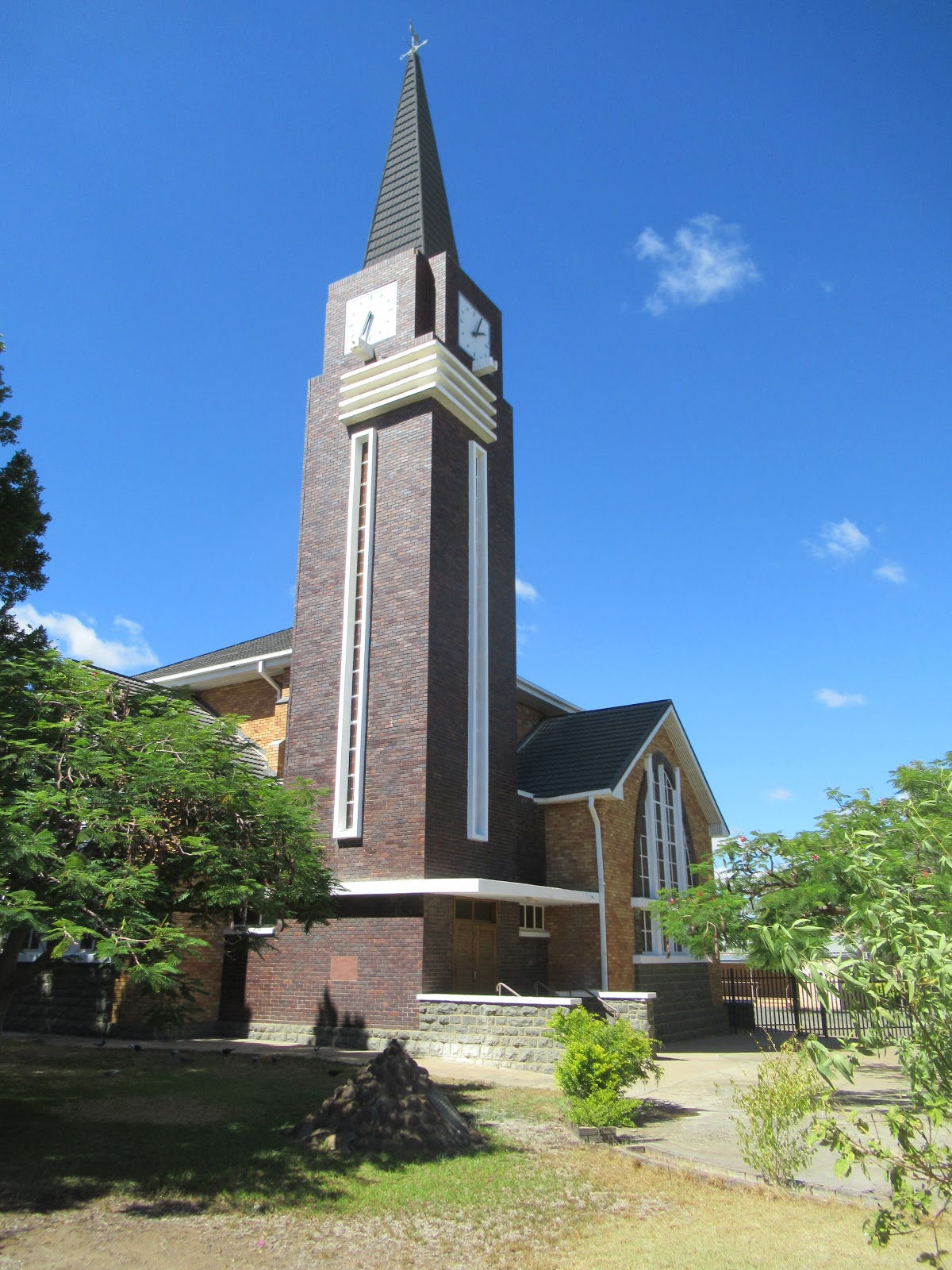
 The modern art deco stye church built in 1926.
 Another view of the clock tower.

 A quiver tree. The wood is very light and porous and when it rains it soaks up the water to store it for sometimes years until it rains again. The very centre of the tree has a soft hollow core with a stronger rim. It is like a scaffolding pole and by blocking one end, it makes a useful quiver to hold arrows.
 The old church, not the one that Dr Hugo Hahn built as that was washed away in a flash flood. This one was built in 1890. It now houses the local museum.

A detail of the church tower.
Inside it has an unusual feature as the pulpit for sermons in central and behind the altar.
 But otherwise is is a typical protestant church with a gallery above the entrance.
 Some of the exhibits outside.

 Then a drive int the desert brought us to the Mesosaurus Camp, one of the top twenty camps in Namibia but I was here to see the fossils.
These fossils are found all over the farm and identical ones are found in Brazil. It proves that the two continents were once joined together some 280m years ago before they drifted apart.


 And yet more quiver trees.
 Two nests of the communal weaver bird. They live in giant nests, up to a hundred pairs with each pair having their own entrance. They are often joined by the pygmy falcon who also lives in the nests and protects it from snakes and lizards.
 A close up of the nest.
 The odd rock formations here are strangely shaped as if they were put together by man, hence the name, The Giants Playground. These particular ones can be hit with a stone and they sound just like a xylophone and tunes can be played on them. Note the white marks where the stones are hit.
 Another quiver tree.
 And yet more quiver trees.
 More blocks.
And aways be careful when taking down your tent as scorpions hide underneath searching for prey. The coin is the size of a ten pence piece for comparison.


Monday, 9 April 2018

Luderitz
After Kolmanskop Ghost Diamond Mining town, it was just 10kms to Ludeeritz. on the coast.
 It is a fascinating place that expanded following the discovery of diamonds and is full of art deco architecture with a German twist. There were many fascinating buildings and I walked around town taking photos of most of the interesting ones.


 Overlooking the town on the top of a hill is the church.
 And around it yet more colourful buildings.


 On a small peninsular jutting into the bay is Shark Island which isn't actually an island but it over looks a small island of the same name. This was were the Herero people were imprisoned following an uprising starting in 1904 against the oppressive rule of the German colonial government. It is a barren, windswept rock but an ideal prison as the currents are dangerous and only a few guards were needed at the narrow neck of the peninsular. Several thousand died here before being released.
 Our hostel had a few quirks such as two ships wheelhouses that had been converted into bedrooms.
 And there was an old railway carriage i the sidings at the station. The original line to Aus and the mainline was built in just ten months to connect the diamond mine to the port of Luderitz and the main network. It fell into disrepair but there was a plan to upgrade and reinstate the line in 2006. Over a decade later work is still going on but it will soon be complete when the signalling equipment has been tested and the sand dunes that have since covered sections of the railway are removed.
Then we headed south of the town to a nature reserve to see flamingoes.
At the end of the peninsular is a lighthouse.
 And beyond it is an old wooden bridge that connects the mainland to a lookout point but it was washed away in storms in 2008 and there is a collection to fund the rebuilding.
  And the Diaz Cross, a navigational aid first erected by Bartolemw Diaz on 27th July 1488.
                                               
 On an island offshore were some seals relaxing on the rocks.
 And on another island was a penguin colony of Fairy Penguins but it was too far away for the camera to get any good close up photos.