Friday, 11 May 2018

Chobe National Park

The Chobe River rises in Angola and is a major tributary of the Zambezi. Part of it forms the border between Namibia and Botswana. It is a national park with a wealth of wildlife and some jungle lodges. This particular lodge also offered sunset cruises on the river to see the wildlife. It was a great place but of course not cheap.
A view of the river from the swimming pool and bar area.
One of the many boats on the river taking clients into the national park to view the wildlife.
A group of elephants. Sadly they were quicker at moving than I was getting my camera out, hence a photo of their hind quarters.
A small crocodile, about eight years old adjust two metres. They grow throughout their life span which can be over 80 years and can reach six metres.
A white backed vulture.
A cormorant drying its feathers.
There were many group of hippos and being in a boat we could get quite close.

A warning that we had got a little too close.
And there were crocodiles in the water swimming past us.
This one was lying in wait for prey and so these ducks had a lucky escape.
A close up of the Egyptian Duck.
A crocodile waiting for some small birds to come and clean his teeth and gums.

A view across an island in the river with a tourist boat on the far side and the steep bank of the Botswana side of the river.
 And of course a sunset cruise finishes with the setting sun and then it was a dash to get out of the national park and back to the lodge before the park shuts.


Thursday, 10 May 2018

Okavango Delta

This was our jumping off point to get into the Okavango Delta, the largest inland delta area in the world where the river empties into the Kalahari making it green. But this area is also great for wildlife but all of it is friendly. There are large crocodiles here and hence the sign.

A view down the river from the lodge.
We were driven from the lodge to the village where we would pick up our canoes or mokoros as they are called locally. They used to be made from ebony trees but are now made out of fibreglass.
There were two people per canoe and a poler pushed us up river. Although I would have preferred to paddle myself, this was very relaxing.
Our path was blocked for a while by some elephants which took their time to cross the channel in front of us but we got very close.
Another view of how close the elephants came to the lead boat.
More pictures of the elephants.
This was where we pulled in to set up camp for the next few nights. It was raining in Angola and the rivers were filling up but the water had not reached the delta yet but in a couple of weeks this area would be under two metres of water.
One of the three baobab trees on our particular island. We used it as a marker so we would never be lost. The ground is flat and open so we could see a long way.
Some of the island had wildfires and the grass is burnt. Not that the path where the grass has been trampled has been left unburnt. But these areas sprout new grass and the zebras like to graze on the new shoots so this is a good place yo spot zebras. They also like these flat open areas as they can see predators form a long way off.

At last we found what we had been promised. A lagoon full of hippos.
 We stayed for an hour waiting to get the right photo. They ae susceptible to sunburn a=from ultraviolet light so stay largely submerged all day and then venture on to land at night to graze.
And there was still plenty of other wildlife to see such as giraffe.
 And more elephants.
And flocks of white pelicans flying home to roost.
 And several wonderful sunsets.

Wednesday, 9 May 2018

Etosha National Park revisited

On our way north towards ultimately Cairo, we stopped off again at Etosha and saw yet more wildlife.

Another zebra but note the alternating ghost strips which differentiates between HArtmans or plains zebras and the mountain zebras.
An elephant with only one tusk.

Another giraffe.
Impala.
Ground squirrels.
 Wildebeest.
A flightless guinea fowl.
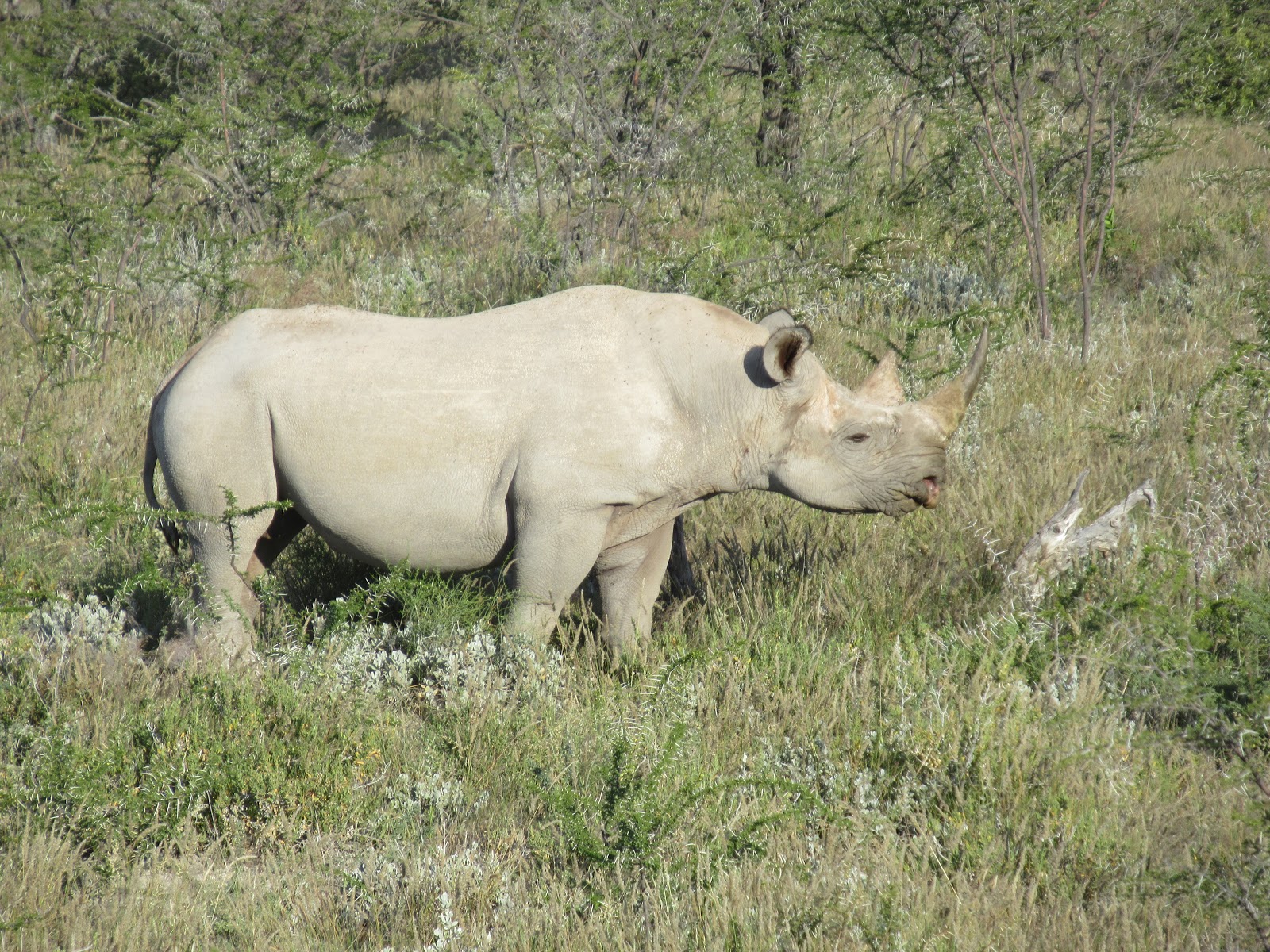
 A white rhino.
Ans en route from Etosha we came to the former largest baobab tree. It used to be the largest baobab tree until 2008 when they found an even bigger baobab.
 An idea of size of how big the girth of the tree actually is.

Monday, 7 May 2018

Spitzkoppe and Cheetah Farm

After Swakopmond we headed to Spitskoppe which is in an area of several large isolated mountains in the desert.
Each is distinctive depending on the angle you see it, both the above and this shot are of the same place.
We got out to see the fauna and flora with a local guide who was very knowledgeable. This is a weaver birds nest. It has two entrances, one which is used everyday. The other is lower down and is an emergency exit. If a snake or lizard climbs onto the the branch, it will sag under the extra weight and this is the cue fir the birds to abandon the nest through the emergency exit.
There were several small holes dug into the sand. The half arch openings were the most dangerous as these were the homes of scorpions. Scorpions with small pincers and thin tails are the most deadly but of course you don't know which one is hiding down the hole.
There are some ancient cave paintings around Spitzkoppe...such as this picture of a rhino...
...and lots of other pictures of elephants....
...people....

...and elsewhere were plant life such as this paper tree, called such as the bark peels off in sheets and can be used just like paper.
An then it was on to Cheetah Farm. This is further north in Namibia and the desert had changed to savannah.
Cheetah Farm is about cheetahs. The animals would prey on the sheep and cattle and would have to be shot. However this farm has large areas reserved for the animals and feeds them as a rescue centre. Instead of shooting the animals, local farmers now trap the animals and deliver them to Cheetah Farm for rehousing.
The main farmhouse is surrounded by a fence and the more placid cheetahs are free to roam around the garden.
And visitors can wander around the garden in the company of free roaming cheetahs.
But there is still a danger as they are still wild animals so you have to be careful.
Some of the cheetahs are less passive and have a reserve to themselves where they can room freely and hunt but have became accustomed to being fed so hang around waiting for the farm 4x4 to turn up and throw them some meat.
There is always a scramble for food and the more aggressive animals grab the first chunks of meat until al the animals have been fed.


Thursday, 3 May 2018

Cape Cross seal colony

We crossed the tropic of Capricorn and stopped for photos.

 We reached Cape Cross seal colony in the afternoon to view the seals on the beach. The males had mated and had gone back to sea. The females were nursing their pups. It was a noisy and smelly place.    

It is called Cape Cross as the first Europeans to reach here were Portuguese and just like at other places along the coast, they erected a cross to serve as a navigation beacon.                                  
                                      
 And there were seals everywhere.
 One of the notice boards surrounded by seals so it was difficult to read without disturbing the seals.
 More seals.
 The seals had also taken over the shelter.
 A view along the beach. There are between 80,000 to 100,000 seals on this beach.
 And however cute, we had to move on.