Tuesday, 20 February 2018

Limbe, Cameroon

We crossed the border opposite Ikom from Nigeria into Cameroon. There are lots of stories to tell but you will have to wait until another time when I am out of the country with better internet. The road from the border to the next town was so much better than the guide book had warned. It used to be bad but it had been upgraded with Chinese money and now was a great road with smooth tarmac and a gigantic viaduct across a river. The picture doesn't do it justice as it curves across the mountain off to the left of the photo.

We reached `Limbe which was to be our location for the next week. We were camping in the grounds of a hotel which overlooked the shore and several islands. And parked in the bay was an oil rig.
A view of some of the islands.
The hotel was positioned on the beach front of the botanical gardens so it was a central peaceful location. The gardens were interesting and one of the top three things to see in the city but it was a lot extra to photograph so I saved my money and unreality, there weren't a lot of unique specimens in the gardens so I didn't miss out.
There had been several Land Rovers on site as part of the gardens vehicle fleet but regrettably they were all now redundant.
 Another of the former fleet.

 And yet another this time almost buried to the tyres.
And the last running vehicle. Just a few spare parts would let them run again but the budget did not stretch to a few extra cheap parts and so perfectly good vehicles lay rusting away. Not such an unusual situation in Africa where capital aid is given to set up a project but there is no extra money for maintenance so the project aims reneger realised long term.

The hotel was a great setting with a bar, restaurant and a pool.
 It over looked the sea but the coast just here is rocky so no sandy beaches. This is the picture at high tide but the rocks and rubbish would dissuade anyone from trying to have a swim in the sea.
A picture of the oil rig just off shore in front of one of the many islands.
 And its support vessel moored just a kilometre away.
 And above the hotel swimming pool with the truck in the right of the picture is the Hot Spot Restaurant which is the best seafood restaurant in Limbe,

And then for me it was the challenge to climb Mount Cameroon, the highest mountain in west Africa.


Friday, 16 February 2018

Abuja and Drill Ranch, Cross River State, Nigeria

We had crossed from Ghana, through Togo, through Benin and were now traversing Nigeria across the centre of the country. We were either bush camping or in camp sites but the internet was poor so I was not able to blog. But on the way to Abuja we passed several fascinating volcanic necks, the central core of a volcano after it has ceased erupting and the cinder cone has been eroded to leave just the solidified throat of the volcano now standing high above the surrounding plain and very resistant to erosion.
 There is not much to do in Abuja, it is the capital but it was formerly Lagos and moved here after the civil war and attempts at succession by Biafra in the 1960's. It has the potential of being a wealthy country but mismanagement and corruption has eaten away at the country's wealth potential. It is a leading member of OPEC with plenty of oil but petrol distribution is haphazard and when there is a delivery, word gets out very quickly and people queue up. The price is about a quarter of what it is at home.
We were only visiting Abuja to get our Cameroon visas but the embassy was shut on a Friday so we would have to wait until Monday to hand them in and perhaps not collect them until Tuesday which was too long. So we went to Plan B to get visas from the consulate in Malabar which is near the border with Cameroon.

But it did mean that we had time to visit Drill Ranch, a primate centre in a national park. The communal eating area.
The food preparation area at Drill Ranch.
We were camping but the facilities were quite rustic. The shower with the blue tank on the roof with steps up to it so you could fill it using a bucket from the well.
A close up of the shower area and the basin. It seems open but there is only a long jungle path to it and there is a bit of rope for you to tie across the path leading to the shower so that other people know that it is in use.
The toilet down another jungle path. It is quite sophisticated considering some of the facilities that we had used. Privacy was obtained using a rope across the path trick.
Then the real reason why we had come it...the pirates. These are endangered drill monkeys within a seven hectare enclosure. There is an extensive breeding programme with several enclosures and plans to release troupes into the wild. A female carrying a youngster.
The dominant male.
Regretfully a blurred photo of the males bum with its colouring.
 A close up of the males face/
The Slave Road, Ouidah, Benin

A had a walking tour around the local village. It had seen better days and there were many deserted buildings. A view down a side street in a lived in area.
One of the many derelict buildings. built in 1932 but now abandoned.
O
Another derelict building. Our tourist ministery guide said it was due to encroachment by the sea but the translator said it was due to fighting during the civil war.
The area is the birth place of voodoo and every village has its guardian diety where offerings are made.
Then we had a boat ride along the river.
The area is important for two major products, fish as in the first basket...
and salt as in the lady's other basket.
This a fish trap, but usually they are set at the bottom of the river rather than this one that has been left dry by the falling tide.
A selection of sea food caught, a shrimp. langoustine and a fish.
Another voodoo good luck diety. This one was to guard against slave traders, and it would wake up the village if they came near.
The entrance to a voodoo temple, but only initiates can enter.
A special tree complete with voodoo covering to tell people not to touch it, and our local translator, a rastafarian.
On the beach was a turtle sanctuary where several types of young turtles are rescued.
Baby leather back turtles.

 In Ouidah itself is the python temple and there are loads of pythons moving about. Sometimes they escape and local people will trap them and return them to the temple.
 Near the centre of the town is the Portuguese fort where slaves were housed until sold and put on ships to be taken across the Atlantic to the Carribbean.
The governors house inside the fort.
The old tree where the slaves were bought and sold. It was from here that they walked down the Slave Road for the 4kms to board ships.
There are various stations all the way down to the coast. One was the Tree of No Return. Slaves would walk around it nine times to gorget their past but also to ensure that their spirit returned to their native land wherever they died.
The Door of No Return. This is a modern interpretation and there was no actual door here but several of the other slave forts had a similar door from which they left the fort to board a ship and never to return.
Next I went to a stilted village in a large lake just along the coast. We boarded a boat to take the one hour journey across the lake to the sailed village.
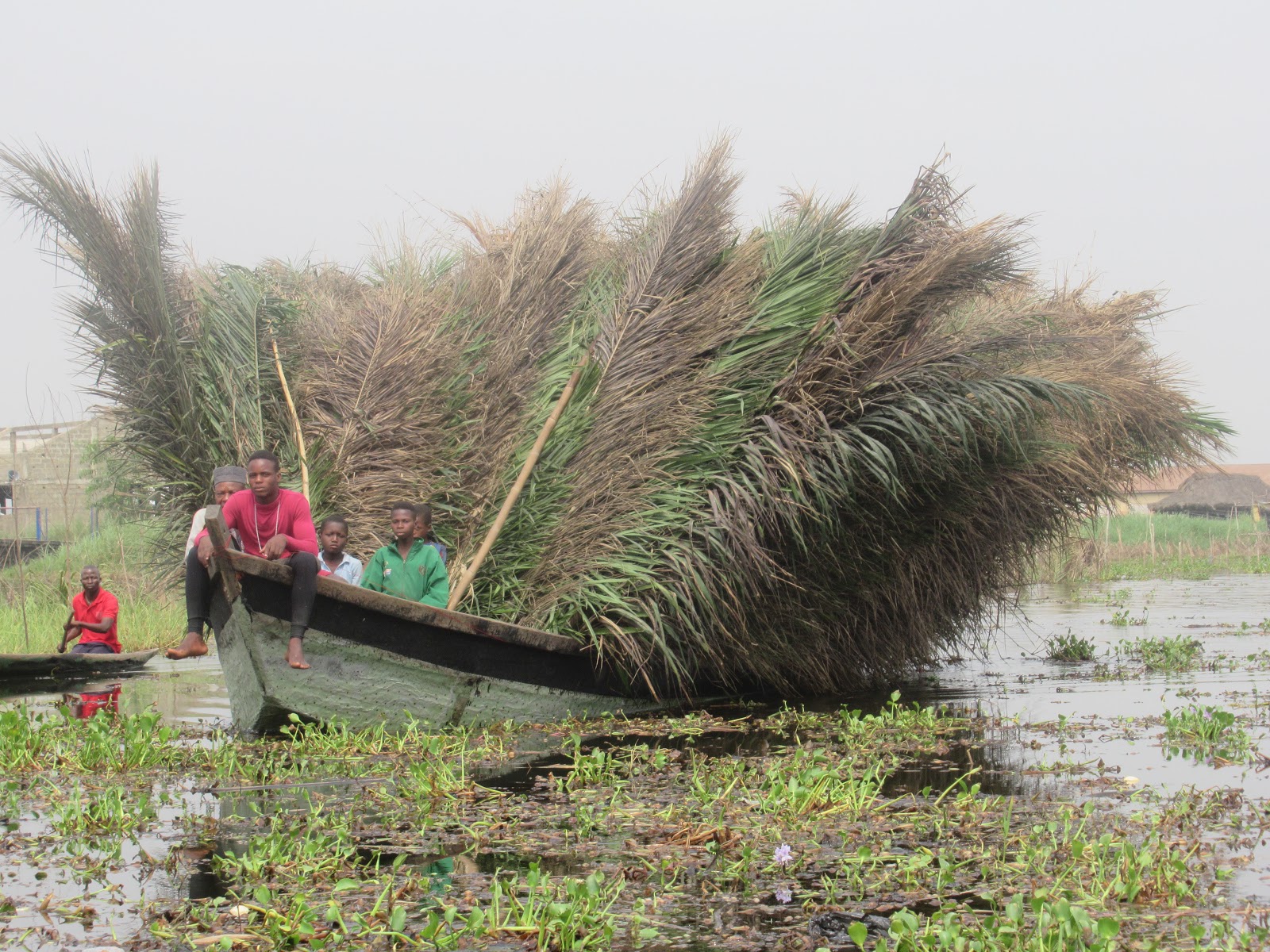
The lake is shallow and a heaven for fish. The fishermen push palm fronds into the soft lake bed to corral the fish into certain areas so that they are easier to catch.
One of the many houses on stilts.
The hotel and bar in the centre of the village. In front of it is the local market where traders paddle their boats loaded with goods to sell.
A close up of some of the traders boats.
One of the many boats that carry palm fronds onto the lake for the fishermen to use.
And lastly, how many can you get on a motor bike. A new record for me with five people on one bike. If it doesn't happen in Africa, it doesn't happen. But now I am looking for six people on a bike!